
Zara displays catalog prices that vary by country, and Japan is increasingly attracting the attention of European shoppers. The depreciation of the yen since 2022 has disrupted the benchmarks: an item sold at the same face value in Tokyo and Paris no longer costs the same once converted into euros. This situation creates a persistent discrepancy that deserves to be examined category by category.
The weak yen, the main driver of Zara’s price differences in Japan
The most direct explanation lies in the currency. The yen has significantly depreciated against the euro since 2022, which means that Zara’s store prices in Japan become mechanically lower for a European visitor, even though Zara has not massively revised its prices in local currency.
This phenomenon affects all international brands present in Japan, not just Zara. Press articles on the cost of living in Japan talk about a “permanent sale effect” for tourists paying in euros or dollars. A t-shirt priced the same as in France turns out to be significantly cheaper in Tokyo after conversion.
To understand where Zara is cheaper between Japan and Europe, it is necessary to distinguish between two realities: the price in local currency (relatively stable) and the price converted into euros (which fluctuates with the exchange rate).

Zara prices by category: basics versus fashion items
Not all Zara items follow the same pricing logic from one country to another. Recent comparative analyses show a recurring pattern.
Basics often cheaper in Japan
Entry-level items (t-shirts, accessories, simple knitwear) are often slightly cheaper in Japan when converted. On these products, Zara maintains competitive prices against local market players in Japan, such as Uniqlo or GU, which dominate the basic segment with tight pricing.
The standardization of these items allows Inditex to contain logistical costs. The Japanese catalog price remains close to that practiced in Spain, the group’s reference country, which, combined with the weak yen, clearly benefits the European buyer passing through.
High-value items cheaper in Europe
The situation reverses for coats, suits, leather shoes, and capsule collections. Products made in Europe remain, on average, cheaper in continental Europe. Shipping costs to Asia, customs duties, and Zara’s higher-end positioning in Japan explain this discrepancy.
A structured coat sold in Madrid or Paris will be offered at a higher price in Tokyo, even after the yen’s decline. The gap widens further on seasonal items and limited editions.
Zara’s global pricing strategy: Spain as the reference point
Inditex uses Spain as a base market to set its prices. Every other country sees its prices adjusted upwards, according to a grid that takes into account local taxes, logistical costs, and competitive positioning.
- In Northern Europe and the UK, the upward adjustments are among the most pronounced due to high operating costs and heavier taxation.
- In Southern Europe (Spain, Portugal), prices remain the lowest on the continent, attracting specific shopping tourism.
- In Japan, the upward adjustment is less pronounced than in other Asian markets, as Zara has to contend with local brand pressure in the entry-level segment.
This mechanism means that the same item can show a gap of over 30% between two countries, excluding the exchange rate effect. Spain remains the country where Zara is structurally the cheapest.
Buying Zara in Japan as a European tourist: what the exchange rate doesn’t tell
Relying solely on the exchange rate to judge the value of a Zara purchase in Japan would be reductive. Several parameters nuance the calculation.
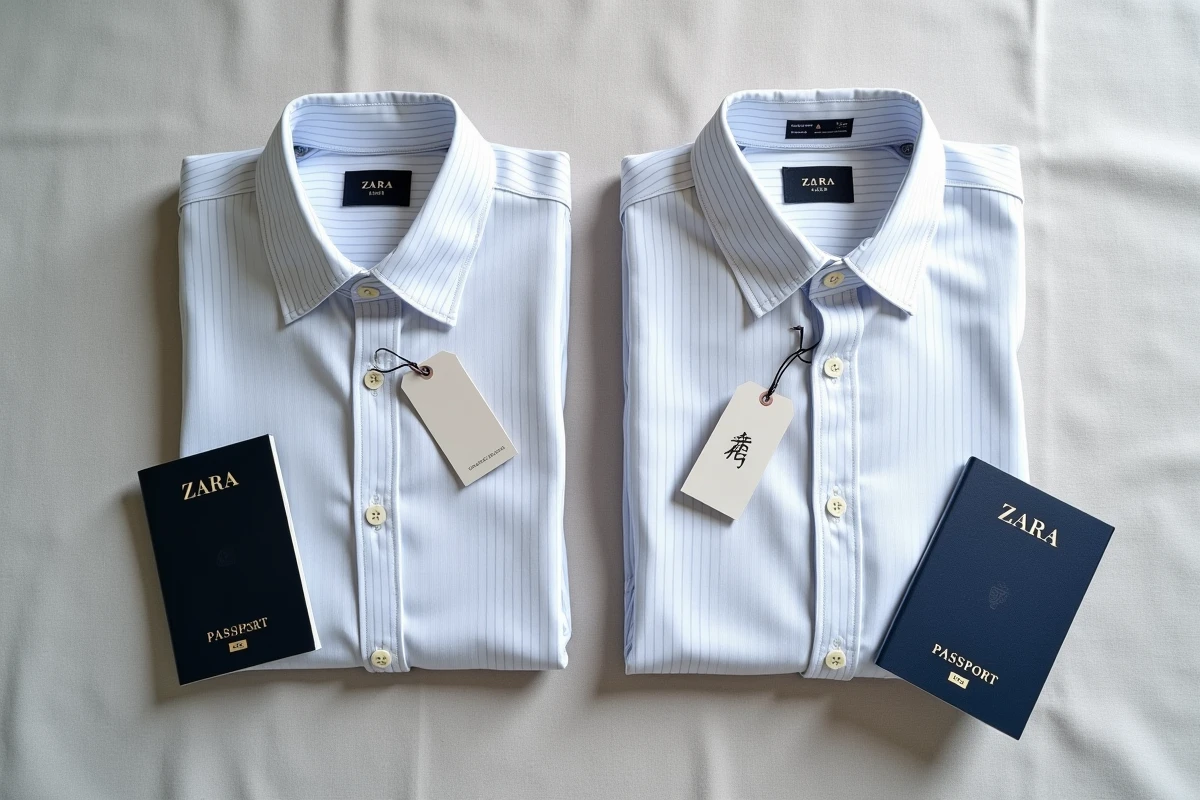
- The tax-free option available in Japan for foreign tourists further reduces the final price. Most Zara stores in Japan offer this scheme upon presentation of a passport.
- Japanese sizes and cuts sometimes differ from European standards. A “cheaper” purchase that doesn’t fit correctly is not a good deal.
- The collections are not identical: some pieces available in Europe are not sold in Japan, and vice versa. Comparing prices assumes comparing exactly identical references.
- The exchange fees applied by banks at the time of card payment eat into part of the gap. The actual savings depend on the payment method used.
Field reports vary on this point: some travelers report significant savings on basics, while others find that the gap narrows on more elaborate pieces.
Zara and the Japanese market: a different positioning from Europe
In Japan, Zara does not occupy the same niche as in France or Spain. The Japanese ready-to-wear market is saturated with local brands offering quality basics at moderate prices. Zara positions itself more as an “accessible European fashion” brand rather than a generalist low-cost player.
This perception influences the pricing policy. Inditex maintains contained prices on basics to stay competitive against local competition, while assuming more comfortable margins on trendy pieces where Japanese competition is less direct.
The group recently launched Lefties, its low-cost brand, targeting Europe, indicating that Inditex is increasingly segmenting its offerings according to markets. In Japan, this segmentation involves a fine-tuning of catalog prices rather than the introduction of new brands.
The price gap between Zara Japan and Zara Europe is therefore not a simple monetary artifact. It reflects two distinct business strategies, adapted to consumers with different expectations. For a European buyer, the current window of opportunity relies as much on the weakness of the yen as on the very structure of prices set by Inditex, and nothing guarantees that this configuration will persist if the Japanese currency strengthens.